Are you considering Shockwave Therapy for chronic pain or a sports injury?
If you’re new to this non-invasive treatment, you likely have questions.
What Happens During a Shockwave Therapy Session?
Before your first treatment, you’ll have an initial consultation with a physiotherapist to confirm the treatment is right for your specific injury. Subsequent appointments generally follow a simple, four-step process listed as below:
- Review: The session begins with a short chat to check on your injury and symptoms and assess your progress.
- Positioning: You’ll be made comfortable, either seated or lying down, depending on the area being treated.
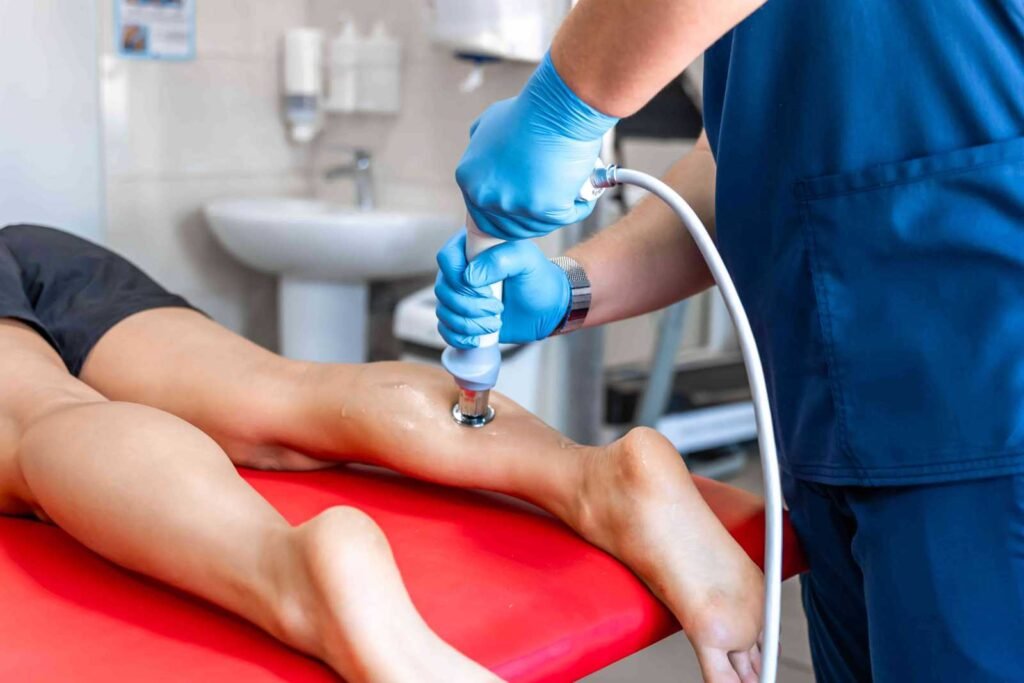
- Gel Application: A special conductive gel is applied to the skin over the target area. This is essential for effectively transmitting the energy waves.
- Treatment: Your physiotherapist will use a handheld wand or probe from a specialized machine. This device delivers short, intense energy waves into the underlying tissues. The waves can be focused (narrow, for a small area) or radial (wider, for an area like a long tendon), based on your specific treatment goal.
Does Shockwave Therapy Hurt?
The machine makes an audible ticking or clicking sound as it uses compressed air to create the waves. You won’t feel pain, but you will feel the treatment. Most people describe it as a strong, rhythmic tapping or pulsing sensation, like an intense vibration right under the skin that may resonate for a second after each ‘tap.’
You may experience mild discomfort because the therapy is designed to create controlled micro-traumas, which is what stimulates the healing response. If it feels too intense, immediately let your physiotherapist know; they can easily adjust the intensity to keep you comfortable. Sensitivity can vary depending on the area being treated, less fleshy parts may be more sensitive.
The Healing Timeline and Recovery
Shockwave Therapy stimulates your body’s natural healing process, so improvements are cumulative over time and multiple sessions. Most people require three to five treatment sessions, spaced about one week apart. Your physiotherapist will monitor your progress and adjust the plan as needed.
While Shockwave Therapy is a safe and highly effective option for soft tissue issues like plantar fasciitis or Tennis Elbow, it is not suitable for everyone. It is important to discuss your full medical history with your physiotherapist, as the treatment may be advised against if you have a cardiac pacemaker, a blood clotting disorder, a metal implant in the treatment area, cancer, or are pregnant or have taken certain medications recently.
Shockwave Therapy works effectively alongside other treatment modalities and offers a powerful, non-invasive way to jumpstart your body’s natural healing process. When chronic pain suggests your recovery has stalled, Shockwave Therapy in Airdrie can help stimulate tissue repair, reduce pain, and restore movement.
FAQs
- Is Shockwave Therapy painful?
Some mild discomfort or tingling may occur during the session. - How soon will I feel results?
Many patients notice improvement within a few sessions. - Are there any side effects?
Temporary redness, swelling, or minor bruising can occur. - How many sessions will I need?
Typically, 3–6 sessions, depending on the condition and severity. - Can I resume normal activities afterward?
Yes, most people can return to daily activities immediately.